How can we look at the same dataset and come to wildly different conclusions?

Image by Ludomił Sawicki on Unsplash
Recently, a study came out where 73 research teams independently analyzed the same data, all trying to test the same hypothesis. Seventy-one of the teams came up with numerical results across a total of 1,253 models. Across these 1,253 different ways of looking at the data, about 58% showed no effect, 17% showed a positive effect, and 25% showed a negative effect. But that's not even the oddest part.  The oddest part is that despite a heroic attempt to do so, the study authors failed to...
More

Seven reasons why you could be defining a concept ineffectively

Photo by icon0.com via Pexels
Note (December 16, 2022): This piece is cross-posted from the Clearer Thinking blog, where it appeared on March 2, 2021. Can a chosen definition be "wrong"? No. If you choose a definition, then you can define a sound or series of characters to mean whatever you want them to mean. For instance, if you wanted, you could declare that whenever you say "phloop," you mean one of those little paper umbrellas that are sometimes found in Piña coladas. That would be weird, but it wouldn't be ...
More

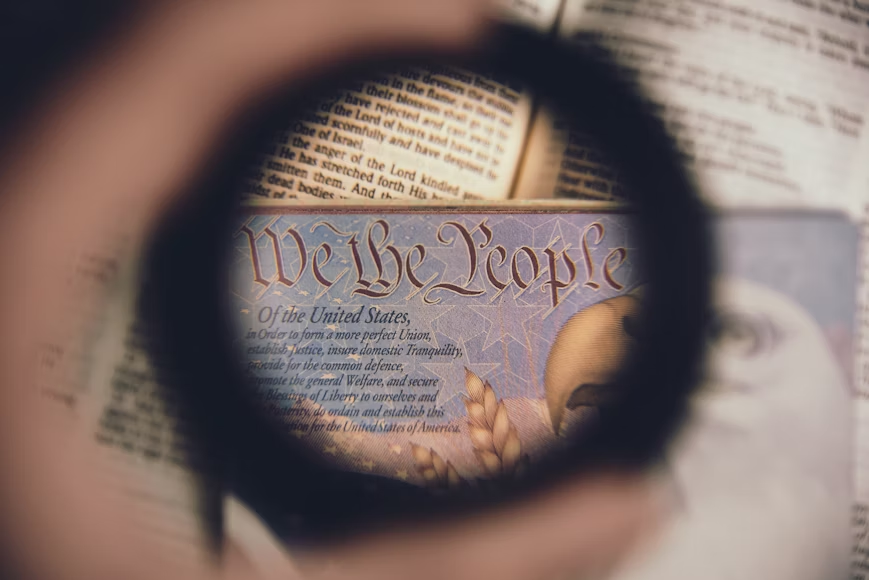
There are at least 8 different ways to interpret the Constitution

Is gun ownership a constitutional right? What about a “right to privacy” that makes it unconstitutional to ban birth control? And can the federal government really use the power to regulate “commerce among the several states” to make laws banning certain plants in cases when they are grown only for private use? I know of 8 approaches to interpreting the U.S. Constitution (and its amendments). None is obviously correct; some are more popular than others, but all are, in some unsatisfying sens...
More