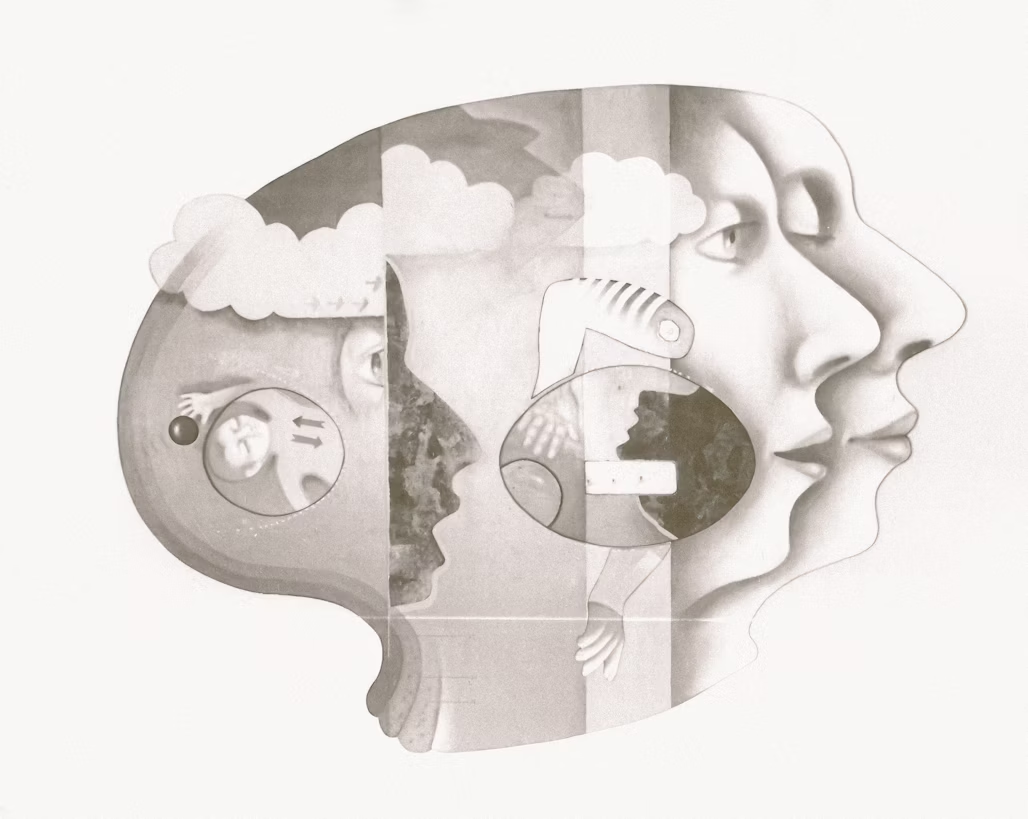
But Does Social Media Use Actually Cause Bad Mental Health?

It's interesting how studies on the negative effects of social media on mental health are mixed: some find an effect, some don't (or only find a very small effect). Some take this as proof that social media is actually fine for mental health. My hypothesis is different. I think that the effects of social media are extremely heterogeneous based on app, population, and dosage: that in some subgroups, some social media apps (when used in high doses) have substantially negative effects on mental...
More

Something Unexpected That May Help Some Common Chronic Medical Conditions

There's something really interesting and potentially important happening in the space of people suffering from chronic medical conditions that modern medicine provides no good solutions for, such as Long COVID, IBS, functional dyspepsia, fibromyalgia, chronic back or joint pain without injury/disease, ME/Chronic Fatigue Syndrome, PTLDS/Chronic Lyme disease, and so on. I'm talking here specifically about people where all other reasonable explanations for their conditions (e.g., cancer, injury, a...
More

The Question Looping Process: how to build great products by asking the right questions

Photo by Pixabay
If you want to build a great product, project, or service, then the "Meta Question" - "What don't I know that I must know?" - should be your obsession. The answer to the Meta Question is itself a question (the "Product Question"). The Product Question might be: "Why do our best users return to our product again and again?" And to answer this question, you ask the Tool Question ("What tools in the tool belt will most effectively and efficiently answer this Product Question?"). These three questi...
More

Anonymized Responses to Taboo Questions – A Social Experiment

If you run a meeting group or like to host events, you may want to try out my event format, "Anonymous Answers to Anonymous Questions," which allows attendees to see each other's (anonymous) answers to controversial, taboo, embarrassing, uncomfortable and rarely asked questions, and then discuss them as a group to discover what they can learn. I've included the details of the event format below, including materials you can use to throw your own version of it. Important Note: this event fo...
More

What People Want Most

What do people want more than anything else in the world? I explored this question by running two little studies across two different populations: mechanical turk (“mturk,” n=49, all U.S.) vs. my Facebook friends (“FB,” n=111, who tend to be in the U.S.) with different approaches, me hand categorizing written responses vs. participants selecting the category that best matches what they wrote using 24 categories in random order developed from the first study, including an “other” option. A...
More

Ways to develop new hypotheses about human psychology

How would you go about building improved models of human psychology so that you can better help people? It might seem nearly impossible at first, but data about psychology is all around us, and there are numerous approaches you could take to discover new insights. Here are 24 different methods you could use to better understand the way humans work. In each case, I use "trying to figure out new things about post-traumatic stress disorder (PTSD)" as an example. What techniques am I leaving out...
More

Predicting Depression

I created simple statistical model (on a sample of people in the U.S.) to help predict how depressed someone is, based on 91 variables about them. I was attempting to predict the severity of the depression by their PHQ9 score, a simple subjective scale that averages scores on 9 common symptoms of depression. For instance, it asks how often you have experienced feeling "down, depressed, or hopeless" and how often you have experienced feeling "tired or having little energy" in the past two weeks....
More

What is the REAL effect of circumcising men?

Those who grow up in the U.S. are often surprised to find out that in many European countries almost no men are circumcised. In the U.S., where the majority of men have had the procedure performed on them, it is pretty common to hear people say that foreskin is unclean, ugly, or even unhealthy. On the other hand, Europeans tend to find the idea of circumcision bizarre. "Why would you cut off a healthy part of your body?", they wonder. And "How would you feel about a culture that cut off their ch...
More

How Journalism Distorts Reality

Journalism provides us with important information about what's going on in the world. But when you consider the incentives that journalists have, combine that with their usual lack of scientific training, and add in the constraints of the medium in which they work, serious distortions of reality can result. Many journalists produce excellent work. But others leave you less informed after reading their articles than before you began. What causes journalistic distortion? 1. Equal time to eac...
More