
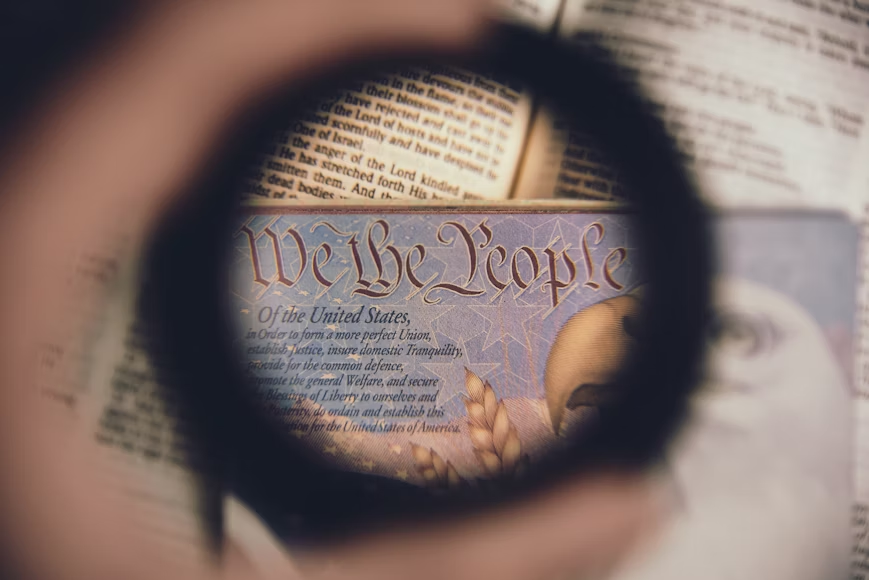
Is gun ownership a constitutional right? What about a “right to privacy” that makes it unconstitutional to ban birth control? And can the federal government really use the power to regulate “commerce among the several states” to make laws banning certain plants in cases when they are grown only for private use?
I know of 8 approaches to interpreting the U.S. Constitution (and its amendments). None is obviously correct; some are more popular than others, but all are, in some unsatisfying sense, an arbitrary choice we could make:
(1) What the authors believed their words were literally saying (for instance, by studying what is known about how James Madison interpreted his writing). Because that tells us what the documents were intended to say.
(2) What the authors were trying to achieve on behalf of our country by writing those words (for instance, by studying what is known about why Alexander Hamilton thought certain things should be in the Constitution). Because this takes into account the spirit, rather than just the letter, of the law.
(3) What did the ratifiers / those who voted to approve the amendments interpret the words as meaning? Because that takes into account the reasons why the documents were actually accepted as law.
(4) What those who first enforced each of the different terms of these documents interpreted them to mean. Because that tells us what the documents first actually meant in practice.
(5) What decisions in our courts most recently interpreted the words to mean? Because that represents the current theoretical state of the law (even though it sometimes changes). There are, of course, good reasons to think we should implement the law as court decisions indicate. What I’m referring to here is something different, namely, when one says that the “correct” interpretations of the Constitution are automatically what the courts have most recently decided they are.
(6) What most people today would interpret the words to mean, if the words are taken at their face value in modern English. Because this is what those words actually mean to us when we read them.
(7) Whichever method of interpretation listed above causes an interpretation most like what we wish the documents said, accompanied by us then arguing that this is always the correct approach to interpretation. This one is especially popular.
(8) Decide what we think the Constitution should have said, then try to find some interpretation of the words that at least sort of makes it sound like it’s saying those things.
—
It would be nice if the Constitution told us which of these methods to use to interpret its pages (though I imagine we’d end up just debating what THOSE words mean too).
It would be even better if we could decide which of these methods would actually produce better outcomes for our society. That’s unfortunately very hard to do.
To some extent, the choice for how to interpret the Constitution hinges on how much we value stability of interpretation (which makes the law more understandable and consistent) vs. achieving certain outcomes we desire (e.g., making sure there are strong protections for things that society feels should be protected). But this dichotomy is not sufficient to allow us to choose between all the different interpretative methods, in my opinion.
Usually, we either seem to treat the Constitution as though it is not ambiguous (a theory that’s unfortunately been falsified) or as though one of these approaches is the “right” way to do it, as though there could be such a thing as one “right” way to interpret an ambiguous document.
This piece was first written on March 20, 2018, and first appeared on my website on September 4, 2025.
Comments